
In this guide
Suppose you open a box and your product is swimming inside like it’s on vacation. Or worse, it’s wedged so tightly you need tools to rescue it. Both situations scream one thing: wrong box dimensions.
Before ordering packaging boxes, understanding lenght width heigh isn’t optional, it’s essential. These three dimensions quietly decide your shipping costs, storage efficiency, product safety, and customer satisfaction. And even the unboxing vibes.
Let’s break length width height dimensions down simply and without turning them into a geometry lecture.
Why Box Dimensions Matter More Than You Think?
Before directly jumping into length width height dimensions, understand why they are so significant. This is because your box packaging isn’t just cardboard; it’s armor for your products. Even small measuring mistakes can cause big headaches. Here’s why getting dimensions right is non-negotiable:
-
Protect Your Products
Keep in mind that a box that fits properly leaves no extra room for chaos. When products don’t rattle around during shipping, breakage risk drops dramatically. As a result, you get happy customers and fewer “damaged item” emails.
-
Keep Your Cost Budget-Friendly
In the modern era, shipping companies do not look at weight anymore. They use Dimensional Weight (DIM weight), meaning the space your box occupies can cost you more than the item inside it. It means a bigger box leads to a bigger bill, while a right-sized box with width and height as well as length, you save money. Take it as simple math and ignore painful consequences.
-
Facilitate Smart Storage
The right measurement of internal and external dimensions allows your boxes to stack neatly in warehouses, on pallets, and inside delivery trucks. In turn, these dimensions (l w h) prevent wasted space with better logistics and smoother operations.
What Exactly Are Length and Width and Height?
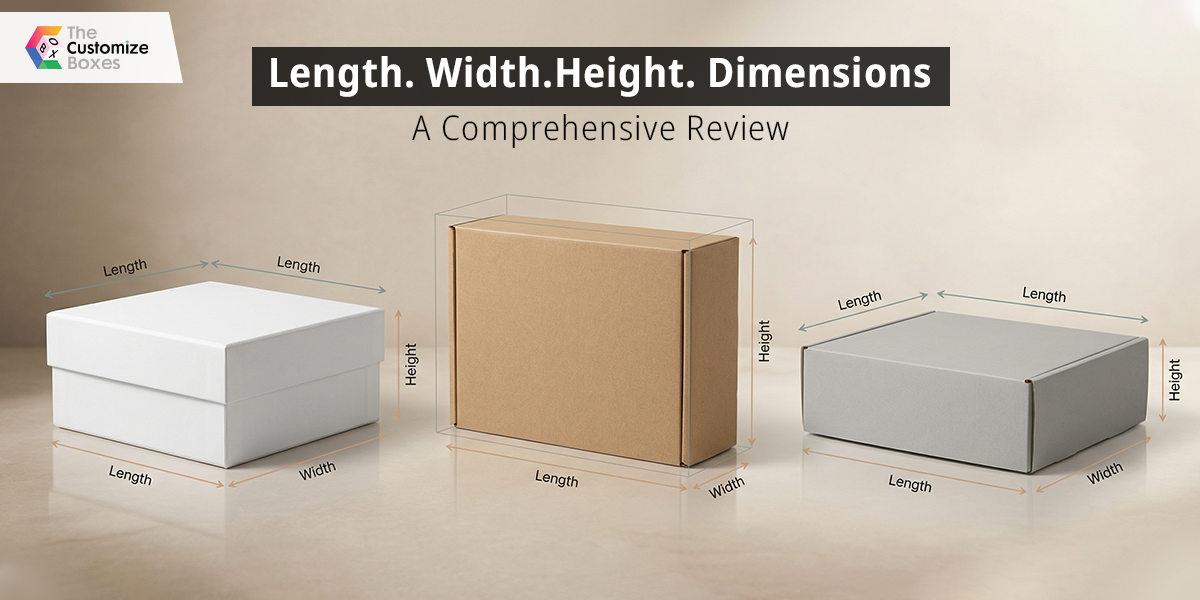
Now that you have read the importance of measuring dimensions correctly, let’s consider their definition. Put simply, the formula Length × Width × Height is used to calculate the volume of physical objects, especially packaging boxes. Here’s what each dimension means in real-world packaging terms:
- What is Length: The longest side of the box base.
- What is Width: The shorter side of the base that is measured perpendicular to the length.
- What is Height: The vertical distance from the bottom of the box to the top.
How to Calculate the Volume of a Box?
To find out shipping rates and dimensional weight, you need to know the volume of the packaging box. The following is the formula to measure the volume of a box:
Volume = Length × Width × Height
Example
For instance, a shipping box measures 16 inches in length, 12 inches in width, and 12 inches in height, then your box volume will be:
Volume = 16 × 12 × 12 = 2,304 cubic inches
That number matters more than you think when carriers calculate shipping costs.
Explore 2D vs 3D Dimensions
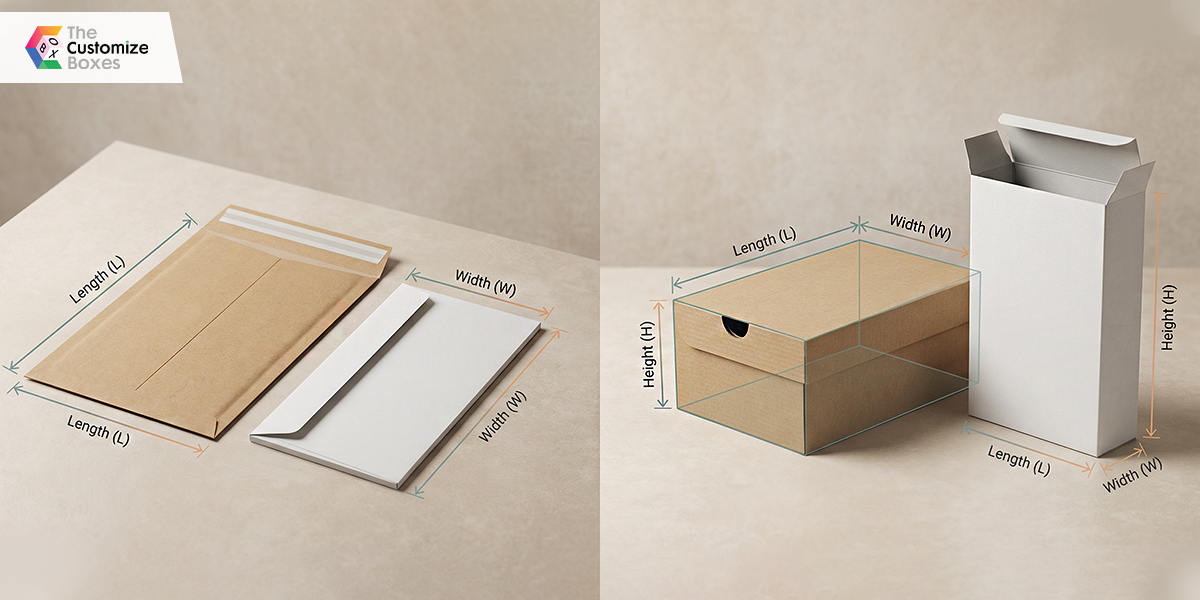
2D dimensions determine the surface area and material required, while 3D dimensions dictate the internal capacity and spatial requirements for storage and shipping. Have a brief overview of them:
- Two-Dimensional Packaging: 2D packaging has length and width only, no depth. Its common examples include document mailers, photo envelopes, and flat artwork packaging.
- Three-Dimensional Packaging: 3D boxes have length, width, and height, meaning they occupy volume. Common examples include shoe boxes, cereal boxes, and product shipping cartons. Simply, if your box can hold air inside, it’s three-dimensional.
The Correct Order: Length × Width × Height
Industry standard follows this order: Length × Width × Height
However, depending on box orientation, brands sometimes adjust the measuring order while math stays the same. Here are common variations, including width, height, and depth:
-
Width Length Height Order
Three basic dimensions remain the same: length, width, and height, but their order may vary depending on your brand's needs. In this order, you first measure height, then width, followed by length. This order is common for vertical boxes.
-
Height Length Width Order
Talking about this order, you will first measure height, followed by length and width. As their formula order will be Height × Length × Width. This order is used for measuring boxes that are placed horizontally.
-
Height Width Length Order
In this order, you first measure height, and secondly, width, and lastly, length. In a mathematical formula, it becomes Height × Width × Length. This order is often used for vertical items or specific packaging where height is the primary focus first. Examples are banners and prints for visual orientation in the graphics industry.
-
Length Height Width Order
This order is common if you see the box from the side view. It will follow the formula order as Length × Height × Width. Turn the box to 90 degrees while looking at your box from the front panel. Then start measuring length, which is smaller than the width and depth (height).
Tidbit: No matter the order, the formula still calculates volume accurately; consistency is what matters.
Length vs Width vs Height
After exploring the formula order variations, consider the differences in length width height of the box here to sharpen your measuring method:
-
Length vs Width
When it comes to length x width (lxw), both sit on the base of the box and form the front face. In the case of cubes and rectangular prisms, the length and width of a rectangle are perpendicular to each other. If you see from the front, these two dimensions merge to form a 2D image of objects. As a result, you get an idea of how long and wide products can be packed inside boxes.
-
Width vs Height
In this case, width and height are also perpendicular to each other. Width runs side-to-side while height runs bottom-to-top. It means from the front view, the height of a cuboid or rectangular prism box often disappears, but it controls depth. Put simply, width and height merge to decide what depth and width of items can be placed inside boxes.
-
Height vs Length
Height gives vertical space while length controls front-to-back depth. Together, they decide how items are placed inside packaging boxes. You can decide the height and length of packaging boxes by measuring the dimensions of items from left to right and front to back.
Real-World Example
Consider an example to understand the measurement of your box dimensions better. Let’s suppose you have a cereal box. From the front, you see a tall vertical side (height) and left to right across the front (width).
But when you turn a cardboard cereal box sideways, you get a narrow side panel that’s length or depth. Typical dimensions of this box are 12 inches in height, 7.5 inches in length, and 2 inches in width.
Why Internal Dimensions Matter Most?
Here’s a pro tip many brands miss that’s always measure internal dimensions. Why? This is because industry standards are based on internal measurements, as products fit based on internal space, not outer walls.
However, the thickness of the material affects the external size, while Internal dimensions ensure your product fits snugly, safely, and stress-free.
Explore Tips for Measuring Box Dimensions Correctly
Here are some notable tips for measuring boxes correctly based on industry standards. Have a look at them:
- Use a measuring tape or ruler based on the box size
- Measure height first, then width, then length
- Measure from inside wall to inside wall
- Double-check measurements because reorders aren’t fun
Consider Tools for Measuring Length Width Height Dimensions
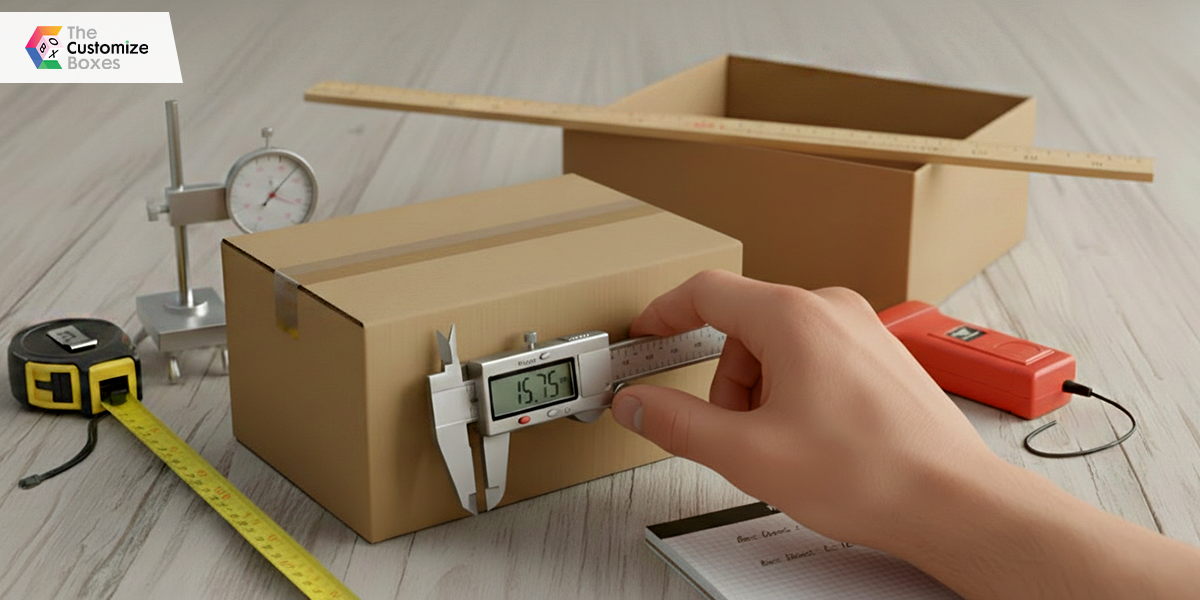
To measure a box's length, width, and height, use a measuring tape for larger cartons, a ruler for small boxes, or a caliper to measure material thickness. Keep in mind that using these tools helps you measure accurately while saving money.
A Step-by-Step Guide on How to Measure a Box
Here is a detailed step-by-step process to determine the measurements of a box. Before taking measurements, ensure you have a tape measure or a rigid ruler. Follow the steps:
- Place the box on a flat, level surface like a table or floor.
- Find the longest side (length) of the box opening that has a flap and measure edge to edge.
- Turn the box 90 degrees to measure the shorter side (width) of the opening that also has a flap.
- Close the box flaps, then measure straight up and down from the bottom of the box to the top edge (do not include the flaps). It will help you find out the height.
- Measure from the inside if you need to check what item fits; measure from the outside if you need size for shipping costs.
How to Write Box Dimensions Properly
Always note dimensions as: Length × Width × Height
For example, mailer box dimensions have length (16 inches), width (12 inches), and height (8 inches). You will write it as: 16″ × 12″ × 8″. This format is universally accepted across the packaging and shipping industries.
Common Mistakes to Avoid When Measuring Box Dimensions
Avoid the common errors mentioned below when measuring box dimensions, such as:
- Recording values out of the standard Length × Width × Height (LxWxH) sequence, which leads to manufacturing or shipping confusion.
Measuring the exterior of a box when you actually need the interior space for your product (or vice versa), resulting in items that do not fit. - Failing to account for the thickness of corrugated cardboard or heavy-duty materials when converting between inner and outer capacities.
Measuring a box while it is warped, resting on a soft surface, or not fully squared up. - Measuring your product tightly without adding clearance for bubble wrap, foam, or protective inserts.
Wrap Up!
Understanding length, width, and height dimensions isn’t just about numbers; it’s about protecting products, cutting costs, and improving logistics. Measure correctly, prioritize internal dimensions, and your packaging will work with you, not against you.
If you’re planning custom-sized packaging, work with The Customize Boxes, which understands that dimensional precision can save you time, money, and unnecessary stress. Because of the right box size? That’s where smooth shipping begins.
Frequently asked questions
What do Length, Width, and Height dimensions mean?
Length, Width, and Height are the three primary dimensions that describe a 3D object's size. Length is typically the longest horizontal measurement, width the shorter horizontal measurement (side-to-side), and height the vertical distance from base to top.
How do you correctly measure L × W × H?
To correctly measure L × W × H, place the object on a flat surface, measure the longest horizontal side of the base as Length (L), the shorter horizontal side as Width (W) (perpendicular to length), and the vertical distance from base to top as Height (H).
Which dimension is measured first: length or width?
Length is generally measured first because it's typically the longest side of the base, followed by the shorter side (width), and then height, in the standard Length x Width x Height (L x W x H) format, especially for packaging, though it can sometimes shift the order.
Are length, width, and height measured inside or outside a box?
Length, width, and height for packaging are typically measured from the inside of the box to determine the usable space for products, ensuring a snug fit, while external measurements are used for shipping volume and palletization.
What tools are used to measure dimensions accurately?
To accurately measure a box, use a reliable measuring tape or ruler for standard checks. But for high precision, especially for internal dimensions or smaller boxes, opt for digital calipers, a specialized box sizer tool, or even laser measuring devices, always ensuring the flaps are closed, and measurements are consistent (L x W x H).
Why are L × W × H dimensions important in packaging?
L x W x H dimensions are significant in packaging for cost efficiency, product protection (minimizing movement), storage optimization (fitting warehouses), and presentation, ensuring the right size fits the product perfectly, prevents damage, and meets logistical needs.
How do I calculate the volume using L × W × H?
To calculate volume using L × W × H, simply multiply the length, width, and height (height) of a rectangular object (like a box or cuboid) together, and remember your answer will be in cubic units (e.g., cm³, m³).
What is the difference between internal and external dimensions?
Internal dimensions measure the usable space inside an object (like a box's capacity), while external dimensions measure the total space the object occupies, including its material thickness, affecting how it fits with other objects or systems.
Can L × W × H change for custom packaging?
Yes, L × W × H change can be fully changed and customized for custom packaging. Custom packaging is specifically designed to accommodate your product’s unique dimensions to ensure a perfect fit.
How do I measure irregularly shaped products?
To measure irregular products, use templating (cardboard, string, contour gauges) for shapes, divide complex objects into simpler geometries, or use physical methods like water displacement for volume, while advanced options include 3D scanning or image processing for high accuracy.