
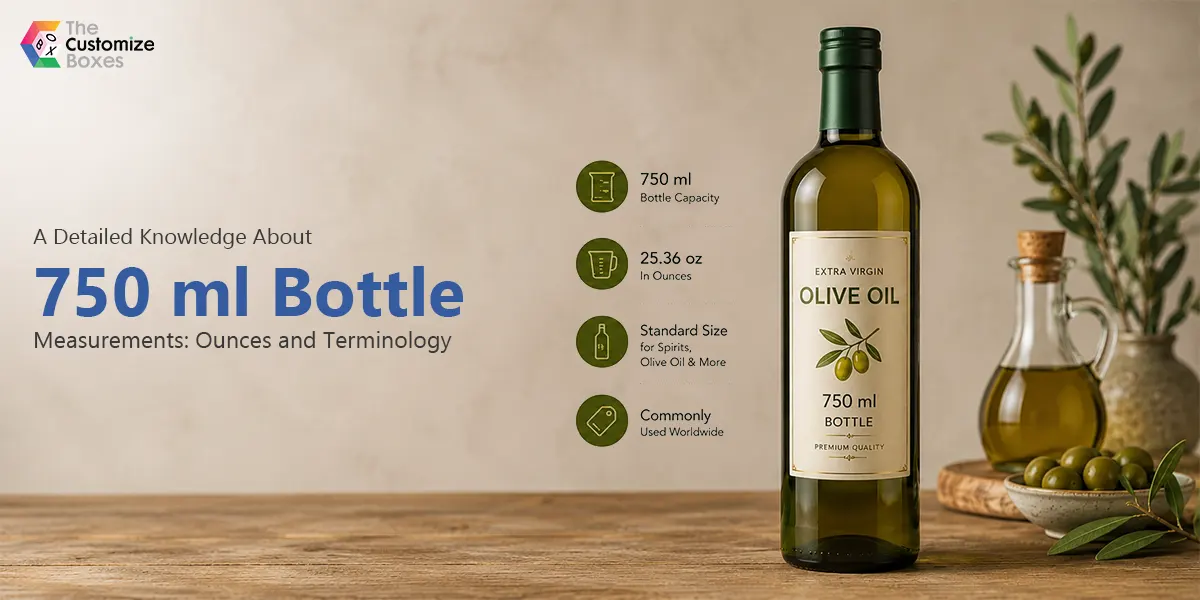
Whether you are in the retail, packaging, or beverage industry, understanding the exact bottle measurements is necessary. One of the most commonly used bottle sizes worldwide is 750ml. This standard size is widely used for spirits, olive oil, and other liquid products.
However, many people often wonder how a 750 ml bottle converts to ounces and what terminology is associated with this bottle.
Let's cover everything you need to know about 750ml bottle measurements, ounces, and industry terminology.
What Is a 750ml Bottle? Understanding Basics
A 750ml bottle is a container that holds 750 milliliters of liquid, which is equivalent to three-quarters of a liter. This is the most commonly used bottle size worldwide, especially for wines and spirits. The volume of the bottle standardizes in many countries, including the United States. At this, it replaced the traditional fifth after the metrication efforts in the 1970s.
Before the immense detailing, it is important to know that we are dealing with fluid ounces (fl oz) and converting milliliters into ounces. Fluid ounces measure the volume, not the weight, which is a common source of confusion when discussing how many oz in a 750ml bottle.
How Many Ounces Are in a 750 ml Bottle?
The conversion from milliliters to fluid ounces depends on whether you are using the US fluid ounces or Imperial fluid ounces.
- 750ml = 25.36 fluid ounces
This is based on the standard that 1ml = 0.033814 fluid ounces. Many people used this for practical purposes, rounding it to approximately 25.4 ounces or even 25.5 ounces. If you are confused about how much 750ml is in terms of everyday use. It is helpful to think of it as slightly more, which could be 25 ounces or about 1.5 points.
Conversion References
If you need to know how many oz are in a 750ml bottle for various applications. Figure out the table below:
|
750ml = |
25.36 US fluid ounces |
|
750ml = |
26.4 Imperial fluid ounces (UK measurement) |
|
750ml = |
3/4 of a liter (0.75L) |
Common Names Used for the Terminology of a 750ml Bottle
The terminology used for the 750ml bottle depends on the different industries.
Standard bottle:
In the industry, this bottle is known as a standard bottle. It is the most common size bottle worldwide.
Fifth:
In the spirit industry, especially in the US, a 750ml bottle is called a fifth. This term originates from the basis that liquor bottles were commonly sold in one-fifth of a US gallon, which equals 757ml.
Bottle
Most refer to this size simply as a bottle because it represents the standard serving size for commercial packaging.
Spirit Bottle
Whiskey, vodka, rum, tequila, gin, and other distilled beverages commonly use the term spirit bottle when packaged in the 750ml format.
Bordeaux / Burgundy Bottles
Regional terminology specific to wine, where the shape of the 750ml bottle dictates its name. Bordeaux bottles have straight sides and high shoulders, whereas Burgundy bottles have sloped shoulders.
Visual References & Practical Applications
How many oz in a 750 can be particularly useful in several contexts mentioned below:
Serving Calculations
For beverages, a 750ml bottle contains approximately 25 ounces, which helps to calculate servings.
- A standard pour is 5 ounces, meaning a 750ml bottle provides about 5 servings
- A typical spirit pour is 1.5 ounces, yielding approximately 16 servings per bottle
Visual References
It can be helpful to know that 750ml is approximately if you need to know the visual references.
- The size of a standard bottle
- About three cups of liquid
- Slightly more than a pint and a half
Measurement Techniques for Accurate Results
The following are measurement techniques: oz is 750 ml for precise applications; several tools can help:
- Graduated cylinders: Provide accurate volume measurements
- Digital kitchen scales: Can measure milliliters when calibrated correctly
- Measuring cups with ml/oz markings: Common in kitchens and bars
When converting between systems, it is important to know whether you are using US fluid ounces or Imperial (UK) fluid ounces, as they differ slightly.
Why Is 750ml the Industry Standard?
Several factors contribute to the popularity of the 750ml bottle:
Consumer Convenience
This size offers enough product for multiple servings without becoming difficult to handle.
Shipping Efficiency
750ml bottles fit efficiently into shipping cartons, reducing transportation costs.
Retail Compatibility
Most retail shelving systems are designed to accommodate standard 750ml bottles.
International Acceptance
The 750ml format is recognized globally, simplifying manufacturing and distribution.
Key Evolving Standards and Trends
The 750 ml bottle, while historically rooted in the wine trade and gallon fractions, is evolving rapidly. Here are key trends:
International Harmonization
While the 750 ml volume is the North American and global benchmark for spirits and wine, it constantly negotiates with European/UK 700 ml standards. Evolving trade standards increasingly require dual-SKU systems (700 ml and 750 ml) to navigate these regional variations.
Sustainable Lightweighting
To mitigate the high carbon footprint of virgin glass production, industry standards are trending toward “lightweight” glass. Modern manufacturing targets a 30-40% reduction in bottle weight without compromising structural integrity or retail shelf compatibility.
Increased Recycled Glass Content
Evolving environmental regulations and life-cycle assessments (LCA) mandate higher integration of crushed, recycled glass into the manufacturing process. Standard production protocols are being updated to utilize up to 90% cullet content to lower furnace emissions.
Future Applications of 750 ml Bottle
Future 750 ml bottles are integrating IoT. Expect to see encoded QR codes, NFC chips, or smart labels to provide consumers with transparent supply-chain data, provenance verification, and digital brand engagement directly from the bottle.
Although traditional soda-lime glass dominates, the future features explorations into highly durable, ultra-thin PET plastics, bag-in-box, and paperboard molds designed to mimic the traditional 750 ml shape while significantly reducing transport and production costs.
Conclusion:
A 750ml bottle is the global standard for and many spirits, holding approximately 25.36 U.S. fluid ounces or 26.40 Imperial fluid ounces. They are referred to as a standard bottle or fifth. Also offers the perfect balance of convenience, portability, and serving capacity. Knowing more about its measurements, terminology, and industry applications can help businesses make informed decisions about packaging.
Whether you are launching a beverage brand, designing custom packaging, or simply curious about bottle sizes. This 750ml bottle remains one of the most versatile and widely recognized packaging formats in the market.
The conversion from milliliters to fluid ounces depends on whether you are using the US fluid ounces or Imperial fluid ounces, but normally it is 750ml = 25.36 fluid ounces.
A standard pour is 5 ounces, meaning a 750ml bottle contains about 5 full glasses.
The height of the 750ml bottle depends; a standard 750ml bottle is typically between 11.5 and 12 inches tall, with a base diameter of about 2.75 to 3 inches.
The empty 750ml bottle weighs approximately 500 to 600 grams. With the liquid poured, it can weigh 1.25 kg.