
Without measurement units, there would be no symmetry in our world. Everything may seem randomly placed, showcasing no sense of sophistication at all. But thanks to the invention of the measuring scales, which allowed us to systemize complex physics into manageable aspects.
In this blog, we’ll dive into the difference between major packaging measurement units, including M, mm, ml, and mil. All of these terms are widely used on and off in the industry, so let’s explore them and learn what they mean.
Human Life Before & After the Invention of Measuring Scales

Since the age of barter, humans have had to rely on some sort of scale that they can use to trade their commodities and get the best return in exchange for their goods. Yet, due to the limitations and scarcity of resources, this concept started falling off as it wasn’t feasible with mass-populated regions.
For instance, an individual or a group may have a bulk quantity of wheat that they want to barter for rice in half the quantity. Unfortunately, the second individual may have the rice, but he isn’t present in that specific geographic location. This turned the exchange of goods into a nightmare, not because they can’t trade it. But the bulk quantity may make it harder to conclude the logistics phases.
However, after the agricultural revolution, all of these aspects were addressed because now humans have developed a standardized system to pay for the things they want to purchase and call it “money”. At the initial states it was gold, metal, and other precious metals, which were later turned into the “paper-money” or “plastic-money”.
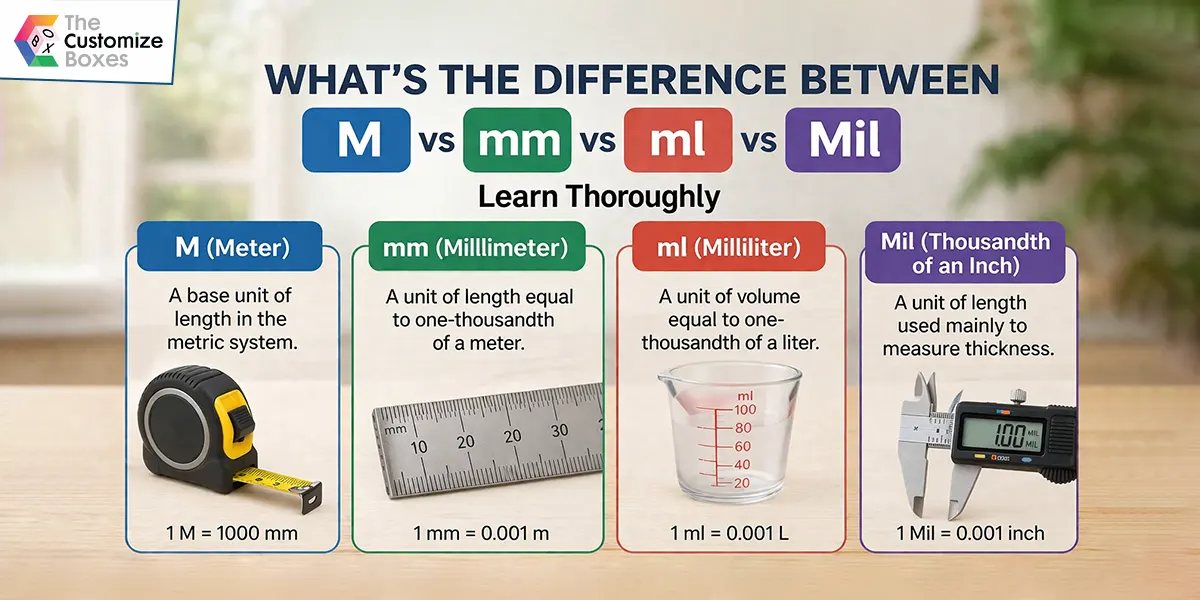
Aside from the monetary side, the main aspect that fixes most of the issues related to the buying and selling of products and commodities is the standardized units. They allow one to sell an item at a significant price with an exact portion size, which we commonly use as M, MM, Ml, Mil.
M (Meter)
First of all, we have the “M” which stands for Metre. It’s a widely used scale to measure the size of an object. Since it’s mostly measured in the vertical direction, it’s a reliable scale to count on for flawless dimensions and distance. Usually 1 metre is equal to:
- 100.000054 Centimeters
- 1000.00054 Millimeters
- 39.3701 Inch
- 3.2808 Foot
Mm (Milimeter)
Secondly, the “mm” stands for millimeter, which is a micro unit to precisely measure the length. Its value is calculated 10-3 (or 1/1000), and that’s why it’s used as a dependable scale in the fields of engineering. For instance, it’s noted as hole diameter: 10.5 mm or depth: 45 mm.
Ml (Milliliter)
Now we have the milliliter (ml), which is the unit of volume to determine the quantity of liquid content, including water, milk, or juice, etc. But it’s used at a smaller scale to measure low-volume items. Take an example of the eye-lens liquid, which is in a small, rounded container with the lubricant of 5 or 7 ml.
If you’re thinking about the “cc”, it’s a similar measuring unit to the ml, but it’s specifically used in the medical industry to gauge the dosages of injections.
Mil
Lastly, for this article, we have the Mil that sounds like “mill”. It’s basically describing the thickness of the material, which is mostly used to communicate about the mylar or plastic packaging material thickness. For instance, a standard visiting card has a thickness of approx 10–20+ mils, or we say it as 1/100 or 20/100 of an inch.
Measuring Scale Difference Table
Below is the difference of the units that allows you to better understand how they’re measured, represented, and utilized in real-world applications.
|
Unit |
Name |
Type |
Definition / Relationship |
Context / Example |
|
m |
Meter |
Length |
Base Unit (SI) |
Standard length measurement (1 m = 1000 mm) |
|
mm |
Millimeter |
Length |
Meter |
High-precision length (10mm = 1cm) |
|
ml |
Milliliter |
Volume |
Liter |
Liquid capacity (1ml =1cc) |
|
mil |
Mil |
Length |
Inch |
Industrial precision (1 mil = 0.0254mm) |
Quick Conversion References
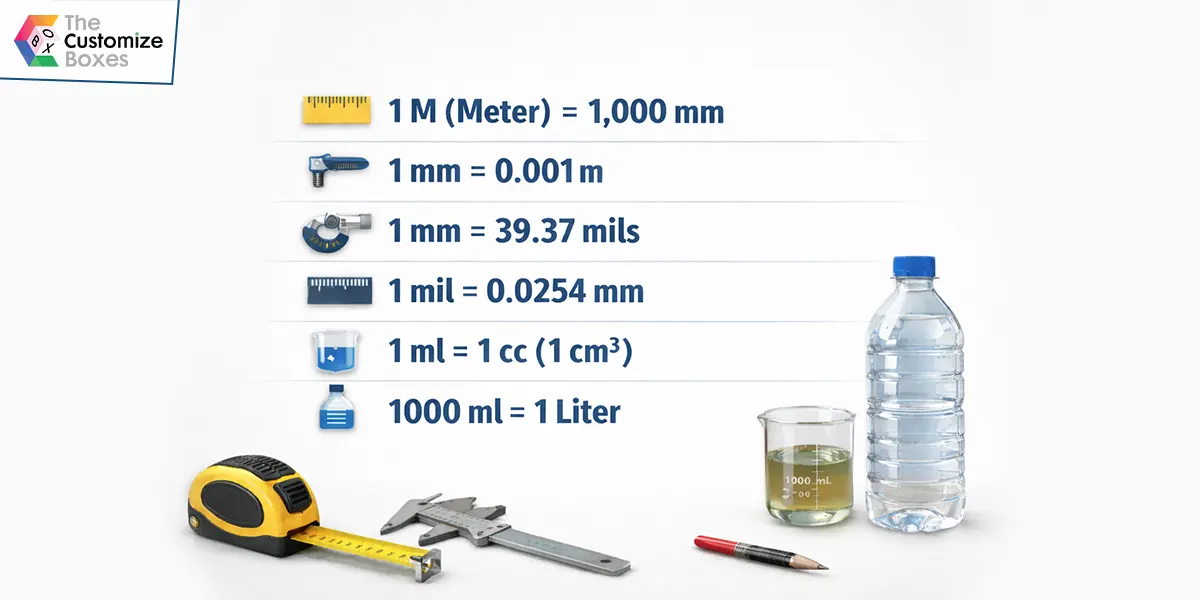
For your better understanding, below are some common conversions that’ll allow you to have a glance at the difference in measuring units.
- 1 M (Meter) = 1,000 mm
- 1mm = 0.001m
- 1 mm = 39.37 mils
- 1mil = 0.0254mm
- 1ml = 1c * m ^ 3 cc)
- 1000ml = 1 Liter
The Bottom Line
All in all, we hope you’re now well aware of the differences between the M, MM, Ml, and Mil. Once these units are at your fingertips, the measurement of packaging will be a no-brainer for you. These can be tricky if you’re calculating for the first time. That’s why we recommend that you consult with The Customize Boxes experts, as they’ll guide you to the best.
Each scale features distinctive measurements for diverse purposes. For instance, mil is a standard unit to calculate the thickness of the Mylar packaging. While mm is used to measure the length of the box or bag, and so on.
The term ml is used to determine the volume of the liquid, while the mil is used to determine the thickness of the packaging material. So, depending upon the packaging demands, each one is utilized accordingly.
Yes, it's common to have a box, bag, or pouch to be measured in multiple units, as it completes the entire purpose of the packaging. For instance, a liquid soap pouch lists its ingredient ml (volume). At the same time, it states the bag’s thickness in mil or mm to indicate strength.