In this guide
Pillow boxes are cute and handy, but they may seem boring if they aren’t printed with the branding elements. This communicates the brand’s message and tells the customer what the packaging is all about. Yet, the main question is what printing techniques are ideal for pillow boxes. Don’t worry, in this article, we’ll explore them through and find out which one suits your packaging needs. So, let’s uncover them.
Top Printing Techniques for Custom Pillow Packaging
From traditional printing techniques to high-tech methods, packaging companies deploy the best-fit one to ensure flawless results. While some of the ones that may fulfill your printing and packaging demands are:
Digital Printing
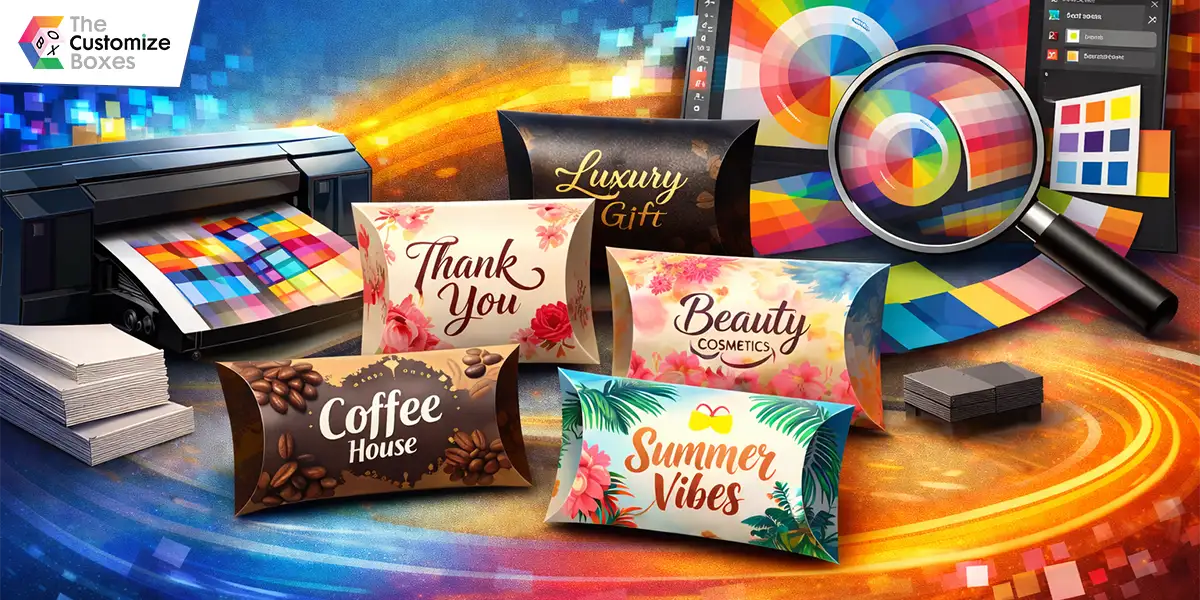
First of all, we have digital printing at the top of our list for the pillow boxes. The mechanism of this method is straightforward: to transfer the digital (pdf) version of the graphics onto the paper. Since the process is seamless, it provides exceptional color accuracy, and all of the printable elements are transferred without any flaw.
Usage of Digital Printing for Pillow Boxes
Some of the common uses for the digital printing method for custom-made pillow boxes include:
- For short runs, ensuring minimum turnaround time.
- For variable printing data such as QR codes, coupon codes, or limited-edition packaging, etc.
- For complex designs that must be printed with attention that don’t leave any detail.
- For a limited budget project, it doesn’t demand high setup costs to run and operate.
Pros
- Speed & Turnaround: Since there are no plates or a complex setup is required, it results in faster production. That’s why you can expect to get the results within a day to handle tight deadlines and dispatch your products on time.
- Cost-Effective Solution: The easy-to-deploy setup demands no extra charges for custom plates and makes it a budget-friendly choice for pillow printing needs at a fraction of the cost.
- Personalization: Due to bulk printing limitations, traditional machines only rely on a single input and produce the same output. Thankfully, with digital printing, you can modify the names, images, or even graphics for each box or bag to target your customers in a tailored way.
- Print-to-Order Solution: Because of the rapid production ability, it reduces the packaging inventory loads, storage costs, and doesn't waste the resourcing of the boxes.
- Expectational Quality: The output quality of digital printing is top-notch, producing detailed images as seen on the digital prints with 100% color consistency on all units.
Cons
- Unsuitable for Bulk: Since it’s great for short runs, it becomes less cost-effective than other printing techniques, such as offset, as the average cost of the printing rises with it.
- CMYK Limitations: Because this method highly depends upon the CMYK mixing, it can sometimes struggle with vibrancy. That’s why, when compared to the traditional inks, outcomes are different.
- Materials & Size: As the printing area of digital printers is limited, it can only print the paper on a specific size and may not fit well for expanded graphic projects.
- Compatibility: Only a few types of materials can be printed because of the texture. Thus, making it viable for packaging that is made of specific types.
Offset Printing (Lithography)
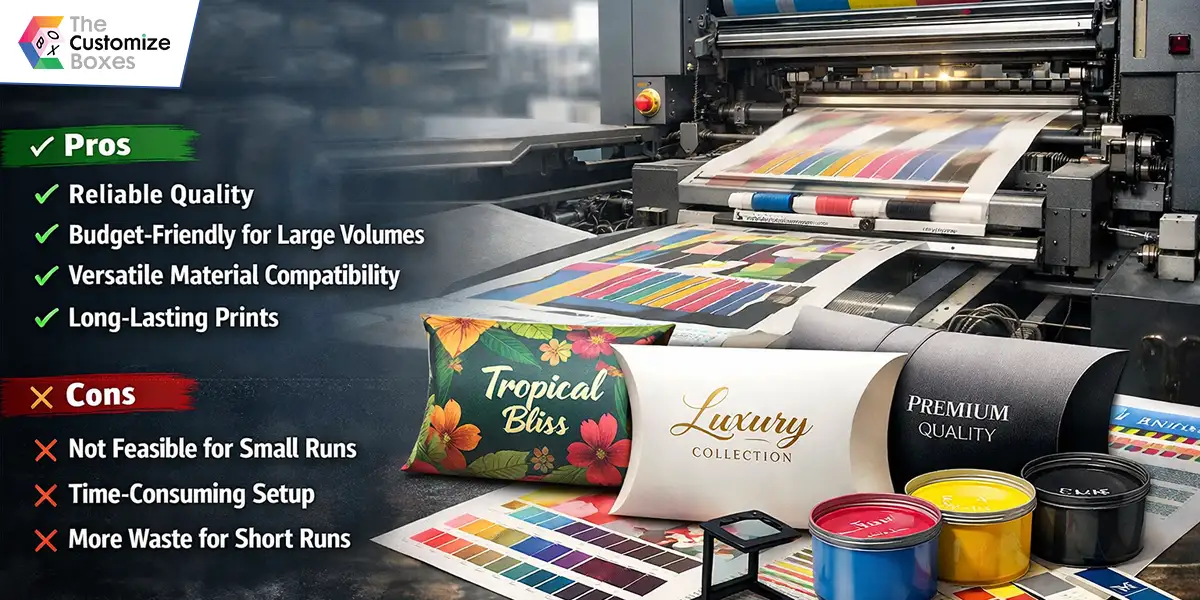
Secondly, we have offset printing, which is the benchmark in the industry when it comes to large volumes for pillow boxes. They produce high-quality and consistent output, ensuring the color matching (CMYK & Pantone) remains top-notch. Since they’re ideal for bulk demands, it minimizes the per-unit cost and allow businesses to secure maximum profits from their products without worrying about printing costs.
Pros
- Reliable Quality: The offset printing results in sharp and vibrant output, even if the images are detailed, and it is developed with exceptional color reproduction. That’s where it ranks well compared to digital printing.
- Budget-friendly: It demands an extensive setup at the start but minimizes the upcoming operational costs. For large quantities, it reduces the average cost and allows businesses to go for bulk printing over a limited demand.
- Compatibility: Whatever materials you want to print on, this technique stands out and works for multiple packaging materials, such as textured, bleached papers, plastics, metals, and even on fabrics as well.
- Stays Last: The prints that are developed using offset printing techniques are more durable, which can be complemented with finishes such as embossing or special coating to enhance the pillow box appeal.
Cons
- Not Feasible for Small Runs: It demands creating custom plates for each color to develop the prints accordingly, which is not only time-consuming but expensive as well. That’s why it becomes an uncountable option for the small printing jobs.
- Time taking: Due to the sophisticated setup, it takes more drying time to conclude the printing phase, which is not ideal for on-demand prints or to cater rush order packaging needs.
- One-time Input Only: Since the printable elements rely on a single input, they can’t be modified once the printing process starts.
- Bad for Planet: When used for small runs, it can produce more waste due to the structural complexities, leading to more waste and landfills.
Flexography (Flexo)
Thirdly, we have the flexography for pillow boxes that benefits from flexible plates and is ideal for large run printing needs. It can be used for a wide range of paper-based pillow materials and works perfectly for less graphic prints that demand a minimalistic approach.
Pros
- High Speed Printing: Similar to offset printing, it can handle bulk-volume printing demands but at a significant speed. While the quick-drying inks reduce the timeline to move forward to the finishing phase.
- Material Flexibility: There’s no limitation when it comes to the materials it can print on. For instance, for the packaging material of paper, plastic films, foils, and corrugated board, they can be printed with flexography.
- Lucrative for Long Runs: Beyond setup costs, its average unit printing cost is so minimal that it makes it a no-brainer to consider it.
- On-the-spot Finishing: Thanks to the quick drying mechanism, it reduces the time to use the box. While allowing it to perform multiple processes, such as varnishing, laminating, or die-cutting in one go.
Cons
- Not Suitable Every Time: As mentioned earlier, it reduces the cost for bulk printing demands. The opposite is the same. Due to plate creation, its price gets high making it an uneconomical option for small print jobs.
- No Instant Prints: Since it requires creating and mounting the plates as per the color combination. This increases the setup time, and getting prints in a short timeframe isn’t feasible by any means.
- Graphics Limitations: Because the plates develop the artwork on the paper, most of the pillow boxes' intricate designs can’t be produced with this printing setup.
- Demand Manual Labor Work: To run the operations for lithography printing, multiple human capital is required to perform activities such as plate placements, adjustments, and fixing the uncertain errors. These all raise the labor costs that reflect in the overall printing budget.
What’s Suitable for Your Pillow Packaging?
All in all, we hope you got a lot of insights on the printing techniques that can be used for pillow boxes. What fits or not for your custom demand can be tricky to answer, but it’s better to consult an expert or reach out to a reliable packaging company. You can write to us at sales@thecustomizeboxes.com or call at (972)-590-8867 to discuss your concerns in detail and get a tailored solution.
Frequently asked questions
Which printing technique is ideal for pillow boxes?
Well, it depends on the project’s budget and demands. For instance, both digital and offset printing is a viable options to consider for pillow packaging needs.
Is it necessary to consider printing for pillow packaging?
You can go with a blank pillow box, but it doesn’t present your product and brand. That’s why it’s better to go with printed boxes to leave a lasting impression on the customers.
Can pillow boxes have multiple finishes?
Yes! A pillow box can have more than one finish on its surface, depending on the customer's demands. For example, the logo of the brand is developed with spot UV finish, while the rest of the surface has matte lamination on it.