
In this guide
Choosing the right packaging can feel like a guessing game. Walk into any warehouse, and you’ll hear words like “mils” thrown around like a secret language. But getting your Mylar bag thickness wrong can mean the difference between a perfectly preserved product and a stale, ruined batch.
You might feel confused about whether to go with the flexible 3 Mil, the balanced 5 Mil, or the heavy-duty 7 Mil. Don't worry! You don't need an engineering degree to figure it out. Let’s decode what these mils mean and find the perfect thickness for your product.
A Quick Answer on Mylar Bag Thickness
If you’re looking for a shortcut, apply the golden rule: a 5 Mil Mylar bag is your best default choice. For most retail products and food items, it hits the absolute sweet spot. 5 mil thickness is tough enough to resist punctures, tight enough to lock in flavor, and strong enough to hold a reliable heat seal.
But if your product is lightweight or only needs to stay fresh short-term, you can easily scale down to 3 Mil. Conversely, if you are packing heavy, sharp-edged items, or prepping bulk goods for long-term storage, you'll want to step up to a heavy-duty 7 Mil shield.
What Exactly is a “Mil”?
Don't let the industry jargon trip you up. In packaging, thickness is measured in “mils.” 1 Mil equals one-thousandth of an inch (0.001"). Or roughly 25.4 microns (making a 5 Mil bag about 127 microns thick).
When you look at Mylar bags, you aren't just looking at a single sheet of plastic. You are looking at a high-barrier, multi-layer foil laminate fused together. Put simply, a higher Mil count means a sturdier seal, greater puncture resistance, and an armor-like barrier against your product’s three primary enemies: oxygen, moisture, and light.
Protection vs. Cost
While “thicker is safer” sounds logical, it isn’t always smarter. Remember, packaging is a balancing act. Thicker materials mean higher production costs. That means they raise your cost per unit. Plus, wrapping a tiny portion of herbs or a lightweight snack in a stiff 7 Mil bag just feels rigid and awkward for the customer.
The goal isn't to buy the thickest bag on the market; it’s to match the material to your specific product. By weighing three simple factors- your product's weight, its physical shape (does it have sharp edges?), and its expected shelf life, you can pick the perfect Mil rating with 100% confidence.
Compare Three Popular Mylar Thicknesses: 3 Mil vs 5 Mil vs 7 Mil
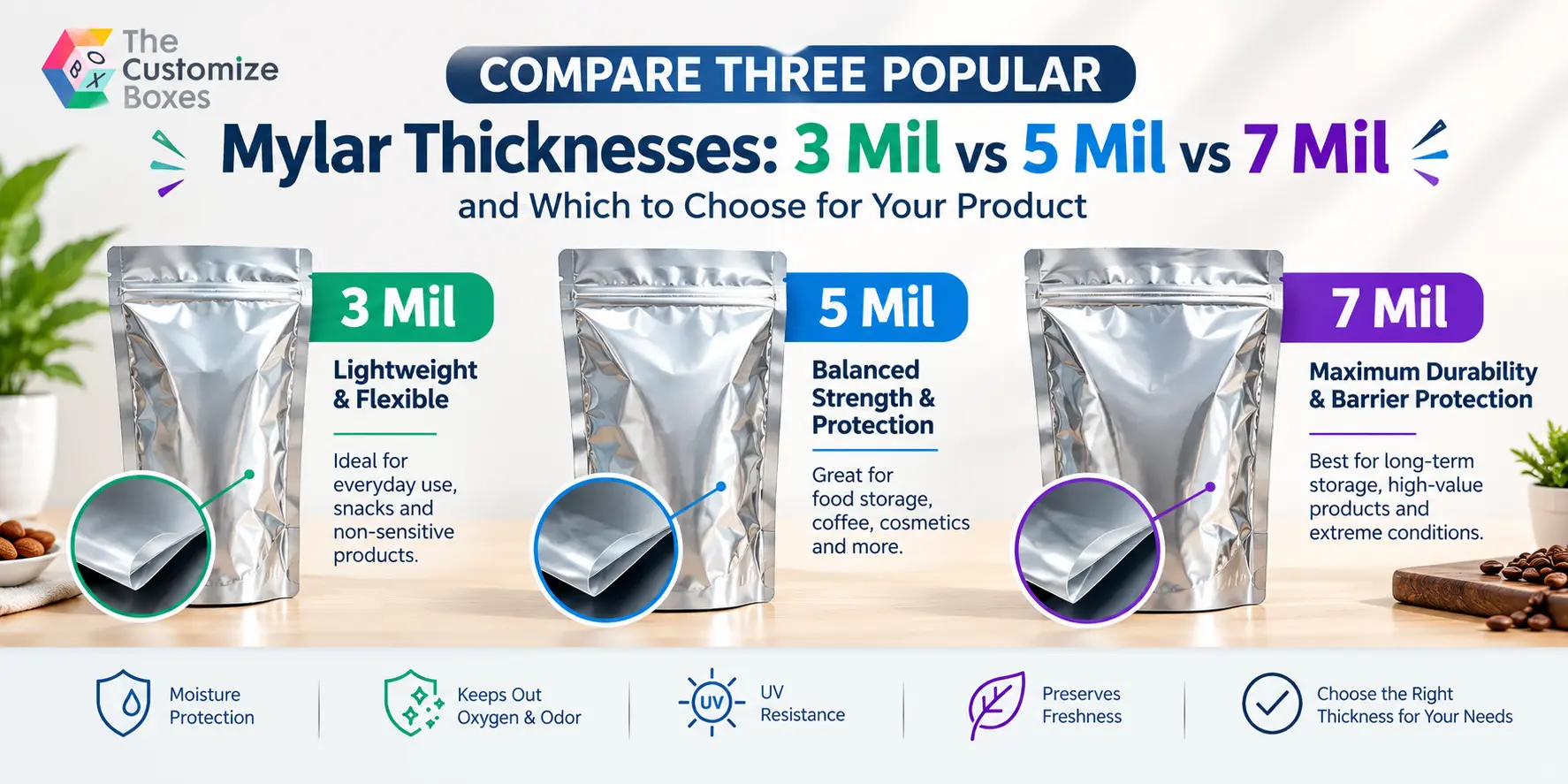
To help you make the right choice for your product line, let’s look at how these three standard thicknesses perform side-by-side:
3 Mil
3 Mil bags are your go-to for standard retail items that won't be sitting on shelves for years. Because they are highly flexible, they conform beautifully to small or uniquely shaped items. They are best for powdered mixes, single-serve snacks, bath salts, pre-ground spices, or small herb portions (1 to 14 grams).
5 Mil
If you aren't sure where to start, start here. 5 Mil is the industry baseline for premium retail packaging. It maintains the ideal balance between heavy-duty protection and cost efficiency, giving your brand a premium, high-quality feel without breaking your budget. You can pack gourmet coffee beans, loose-leaf teas, dried fruits, nuts, pet treats, and mid-sized dry goods (up to a few pounds) in these mylar pouches.
7 Mil
7 Mil bags mean business. This thickness behaves less like a flexible pouch and more like a structured armor shield. It is specifically designed to survive intense handling, rough transit, and the extreme compression that happens when using heavy oxygen absorbers.
They are best for freeze-dried prepper supplies, long-term emergency grain storage, bulk beans, rice, and items with sharp edges like dehydrated pasta or hard candies.
Comparison Table: 3 mil vs 5 mil vs 7 mil
|
Feature |
3 Mil Mylar Bags |
5 Mil Mylar Bags |
7 Mil Mylar Bags |
|
Primary Use |
Short-term retail & light snacks |
Everyday commercial default |
Long-term food & heavy bulk storage |
|
Flexibility |
High (very pliable, crinkles easily) |
Moderate (sturdy, holds its shape) |
Low (stiff, rigid barrier protection) |
|
Puncture Resistance |
Low (susceptible to sharp edges) |
Good (handles standard shipping well) |
Excellent (resists tears from dense/sharp items) |
|
Light & Oxygen Barrier |
Basic (best for fast-moving goods) |
High (excellent freshness retention) |
Maximum (optimal total isolation) |
|
Relative Unit Cost |
Lowest cost |
Moderate/Standard |
Highest cost |
Which Thickness to Choose for Your Product?
The secret to choosing the right thickness comes down to three things: your product's weight, how sharp its edges are, and how long it needs to stay sealed. Let’s look at how the main product categories stack up.
Coffee
For most roasted coffee beans, a 5 Mil Mylar bag is the ultimate sweet spot because it provides a rock-solid barrier to lock in fresh aromas, easily handles rough retail shipping, and holds a secure, airtight seal around a one-way degassing valve.
If you are only packaging lightweight single-serve sample sachets, you can easily scale down to 3 Mil to keep your production costs low.
Food and Dry Goods
Standard snacks, jerky, dried fruits, and dry mixes generally require a 3 Mil to 5 Mil thickness to stay fresh on store shelves. While lightweight items do perfectly fine in a flexible 3 Mil pouch, you should always lean toward a sturdier 5 Mil wall if your contents are dense or if the bags will be stacked heavily inside delivery trucks.
Powders and Supplements
Protein powders, fine spices, and drink mixes should always be packaged in a 5 Mil Mylar bag. Because fine powder particles have a sneaky habit of migrating into the seams during the filling process, a thicker 5 Mil wall provides the necessary structural support to ensure your full-width heat seal stays tightly locked and won't burst under pressure.
Bulk and Long-Term Storage
When preserving bulk grains, beans, rice, or emergency prepper supplies, a heavy-duty 5 Mil to 7 Mil bag is absolutely mandatory. Heavy contents and sharp, jagged grain edges will easily puncture thinner materials, and these extra-thick walls are specially engineered to withstand the extreme vacuum pressure created by long-term oxygen absorbers.
Which Mil Should You Choose?
Choose 3 Mil if you are packaging lightweight samples, short-turnover retail items, or non-sharp dry goods meant to be consumed within a few weeks or months. But 5 Mil is best when you want commercial retail products, coffee, or medium-term pantry storage lasting up to a couple of years.
7 Mil bags serve best if you are doing multi-year/decades-long emergency prepping, shipping heavy or sharp contents like pasta or freeze-dried foods, or need maximum structural protection. Contact packaging experts at The Customize Boxes if you need further help choosing the right thickness for your Mylar bags!
Frequently asked questions
What is the best thickness for Mylar bags?
The best thickness for Mylar bags depends on your storage goal. 3.5 to 5 mil works best for short-term retail and general use. However, 5.5 to 7+ mil is best for long-term food storage and heavy-duty protection.
Which is thicker, 5 mil or 7 mil?
5 mil is thicker than 7 mil. 5 mil equals 0.005 inches (or 0.127 mm) in thickness. However, 7 mil equals 0.007 inches (or 0.1778 mm) in thickness.
What mil is best for Mylar bags?
The best Mylar bag thickness depends on your specific use case. Generally, 3.5 to 5 mil is the best general-purpose choice for retail foods.
What size is a 7 mil Mylar bag?
A "7 mil" rating refers to the thickness of the film (7 thousandths of an inch, or about 177.8 microns), not the physical dimensions of the bag.