
In this guide
In the US and Canada, ounces and milliliters are frequently used to measure the volume or capacity of liquid-based items. These units of measurement are often used for both industrial and commercial reasons. Ounces and milliliters provide a standardized way to quantify substances, whether you are doing everyday culinary, manufacturing, or scientific research.
In this blog, we will discuss the relationship between ounces and millimeters, the conversion procedure, and how understanding these units will ensure the correct net quantity labeling and measurements.
Understanding Ounces and Millimeters (ml to oz)
Before converting milliliters to ounces, let’s understand the basics of ounces and milliliters, background, and uses for a better understanding of the conversion formula. Read on!
-
What are Milliliters?
When a baker, manufacturer, or cosmetic brand owner deals with liquid-based items, the fundamental unit used to calculate volume is considered a milliliter. This provides a precise and standardized means to quantify liquids. A milliliter is equivalent to one-thousandth of a liter and is used to measure lesser amounts of liquid. An abbreviation for a milliliter is ml or mL.
Milliliters is recognized and adopted worldwide for its cohesive and easily scalable approach to measuring volume. This unit is used in many industries, for instance, in scientific research, culinary arts, healthcare, pharmaceutical, and other industrial applications. Being a fundamental unit in the metric system, milliliters provides a universal standard for measuring liquid volumes.
-
History of Milliliters
Milliliters were established during the French Revolution as a decimal-based system of measurements to solve logical problems. This unit of volume in the metric system represents one-thousandth of a liter.
-
What are Ounces?
Ounces are considered the smallest unit of mass and are abbreviated as oz. ounces are widely used in countries that follow imperial systems in most of their work, for instance, personal care products, beverage measurements, culinary, and other consumer goods.
Whether you are a professional, manufacturer, individual, or an industry that relies on accurate liquid volume measurements, understanding ounces is essential. It acts as a bridge between measurement systems, providing clarity in various contexts.
-
History of Ounces
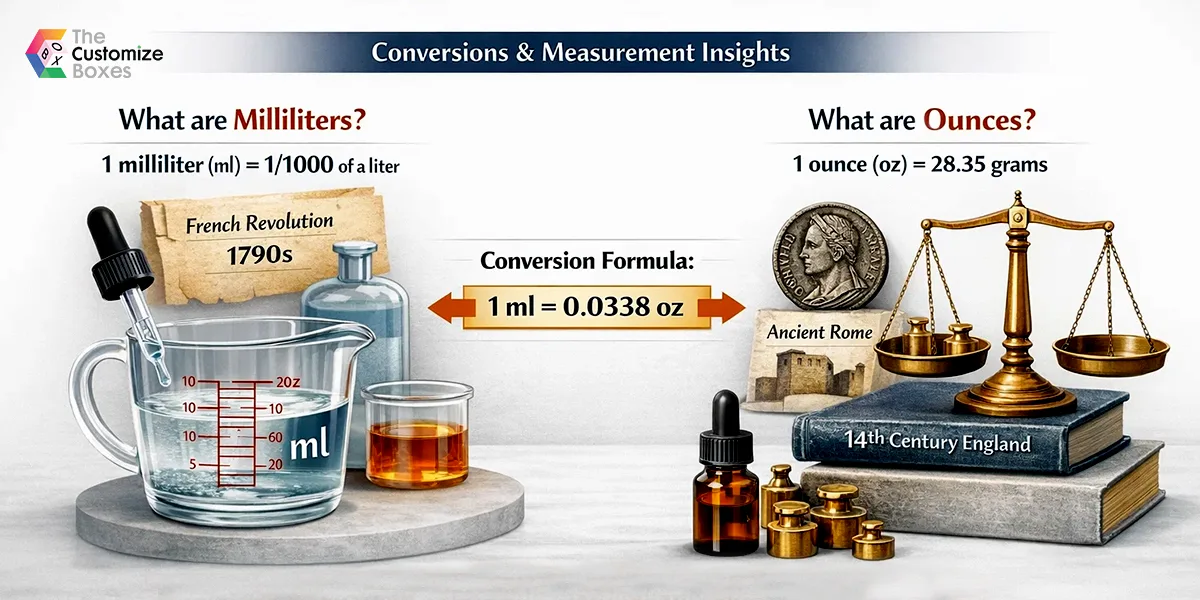
Ounces originate from the Roman uncia, meaning “a twelfth part” of a Roman pound, dating back to ancient Rome. It was standardized in England in the 14th century and standardized internationally in 1959, with 1 oz equal to 28.35 grams.
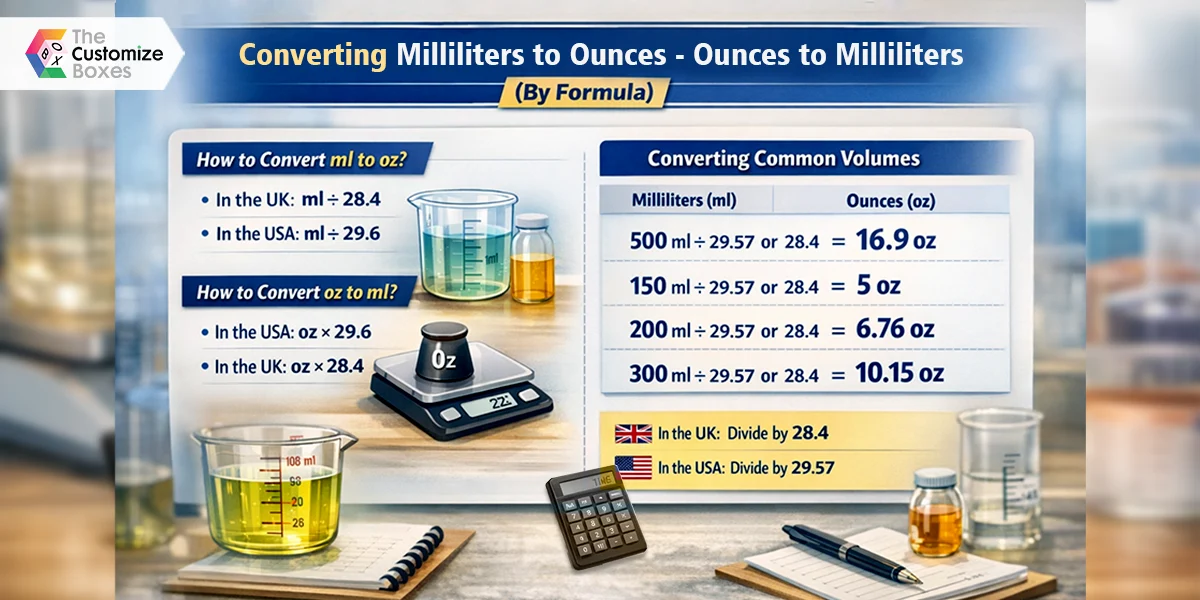
Converting Milliliters to Ounces - Ounces to Milliliters (By Formula)
Here are simple conversion formulas converting milliliters to ounces and ounces into milliliters:
How to convert ml to oz?
To convert ml to oz:
- Measure your volume in ml.
- If you're in the UK, divide the value by 28.4.
- If you're in the USA, divide the amount in ml by 29.6
How to convert oz to ml?
To convert oz to ml:
- Find your amount in oz.
- If you're in the USA, multiply the value by 29.6.
- If you're in the UK, times the amount in oz by 28.4.
Converting Common Numbers From ml to oz
To convert 500ml to oz:
- If you’re in the USA, divide 500 by 29.57
- If you’re in the UK, divide 500 by 28.4
- Result: You get about 16.9 ounces.
To convert 150 ml to oz:
- Divide 150 by 29.57
- Or divide 150 by 28.4
- The result is approximately 5oz
To convert 200ml to oz:
- Divide 200 by 29.57
- Or divide 200 by 28.4
- The result is approximately 6.76 fluid ounces
To convert 300 ml to oz:
- Divide 300 by 29.57
- Or, divide 300 by 28.4
- The result is approximately 10.15.
Milliliters to Fluid Ounces Conversion Table
|
Milliliters (mL) |
Fluid Ounces (fl oz) |
|
1 mL |
0.033814 fl oz |
|
2 mL |
0.067628 fl oz |
|
3 mL |
0.101442 fl oz |
|
4 mL |
0.135256 fl oz |
|
5 mL |
0.16907 fl oz |
|
6 mL |
0.202884 fl oz |
|
7 mL |
0.236698 fl oz |
|
8 mL |
0.270512 fl oz |
|
9 mL |
0.304326 fl oz |
|
10 mL |
0.33814 fl o |
What are the General Uses of Millimeter?
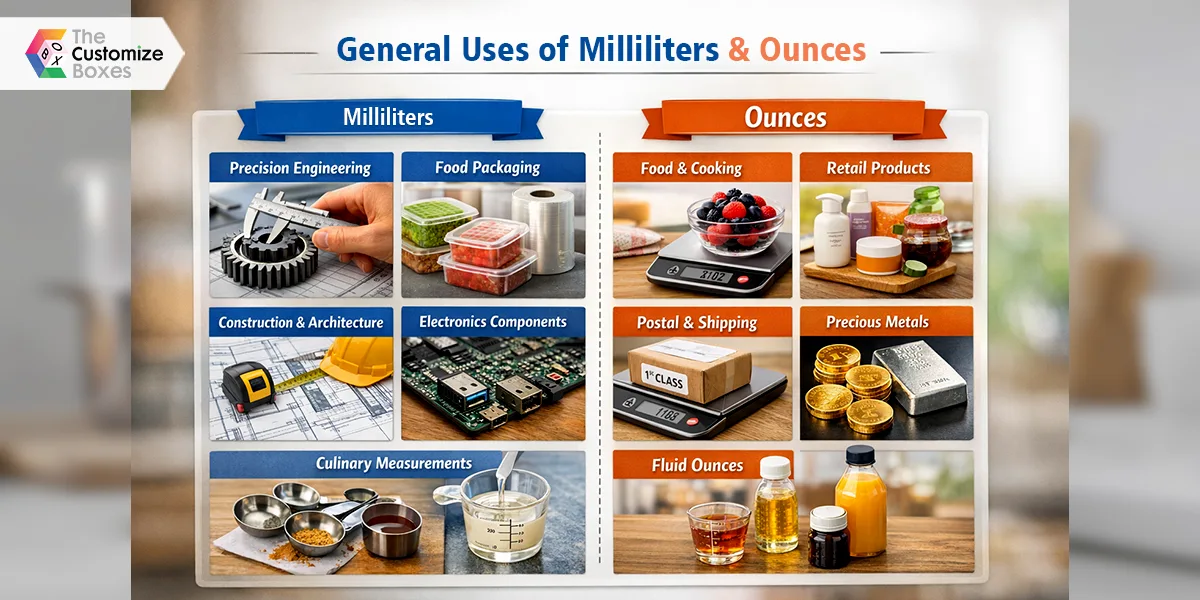
Here are the general uses of millimeters:
- Precision Engineering and Manufacturing: Used for precision components in machinery, cars, and robotics to ensure parts fit together perfectly.
- Food Packaging: In food packaging, millimeters are essential for defining the structural dimensions of containers and the thickness of protective plastic films.
- Construction and Architecture: Builders and architects use millimeters to ensure structures are constructed exactly right, where a few millimeters off can cause significant issues.
- Electronics Component Specifications: Used for component specifications, such as the width of USB connectors, resistor sizes, and circuit design.
- Culinary arts: Milliliters offer chefs and home cooks a precise and consistent unit for measuring liquids in recipes
What are the General Uses of Ounces?
Here are the general uses of Ounces:
- Food and Cooking: Recipes, particularly in the US, use ounces for precise ingredient measurements.
- Retail Boxes: Small products like personal care items, stationery, and dry food items are often weighed in ounces.
- Postal and Shipping: Mail and small packages are weighed in ounces to calculate postage fees, as first-class stamps cover up to a certain ounce threshold.
- Precious Metals (Troy Ounce): Specialized troy ounces are used for valuing gold, silver, platinum, and palladium, with one troy ounce equaling approximately 31.1 grams.
- Liquid Volume (Fluid Ounces): Used for measuring liquids, including beverages, medicine doses, and personal care liquids.
Conclusion
Milliliters are those units that we encounter in our daily routine. Knowing the conversion formula can help you easily and accurately measure milliliters to ounces or ounces to milliliters. If you don’t have a calculator or tech advances, use the previously mentioned formula, and you are good to go!
Frequently asked questions
How much is 1 oz in mL?
Applying the formula - ML = Ounces × 29.5735. Ml = 1 × 29.5735 = 29.5735 ml. Thus, 1 ounce equals 29.5735 ml.
How do I convert milliliters to fluid ounces in everyday cooking?
To convert milliliters (ml) to fluid ounces (fl oz) in cooking, divide the milliliter value by 30 for a quick, accurate approximation. For example, 150ml divided by 30 is roughly 5 fl oz. A reliable rule of thumb is that 100 ml is approximately 3.4 fluid ounces.
Is 30 mL the same as 1 oz?
No, 30 mL does not equate to one ounce. 1 oz (ounce) equals 29.5735 mL or just under 30 mL. They are rounded up to 30 when it comes to nutrition labelling.