
In this guide
From home chefs to kitchen experts, there’s always involvement in measuring units for ingredients. While cup quality is among the top of the discussion to determine the exact quantity of vinegar, water, or liquid-based content. But since it’s mostly mentioned in milliliters, things get confusing even for the experienced ones.
Though the measurement is pre-defined, until they’re converted, it becomes tricky to follow. Yet, if you’re assuming how much a quarter of a liter equals a cup or vice versa, here we’ll learn that conversion in detail. So, read our guide to better understand the process rather than relying on guess pouring measurements.
Understand the Concept First
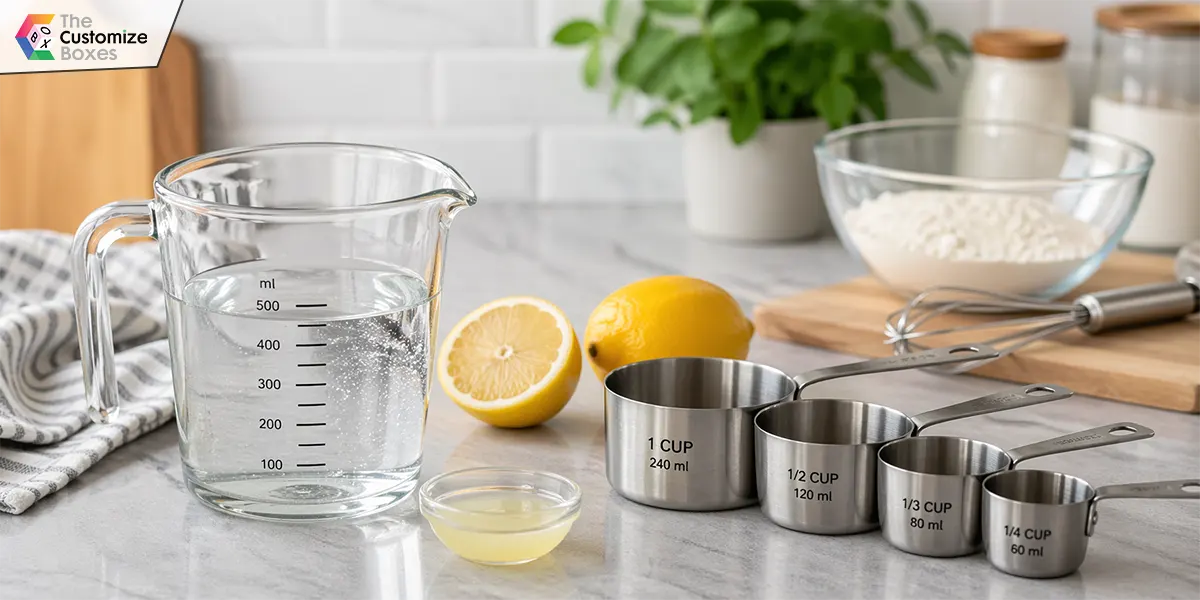
You may ask why we need to do these calculations just to get how many cups equal some milliliters of liquid. Well, in multiple regions of the world, the cups are taken as the standard mode of measuring the quantity of content.
Rather than mentioning the multi-digit numbers of milliliters, they are simply referred to as cups, that reduce the mental work at large. You may list in many recipes such as this and that ingredient, 3 cups of water, ¼ cup of lemon juice, and more.
What Is a Milliliter (mL)?
A milliliter (mL) is a metric unit of volume used worldwide to measure liquids. It is part of the International System of Units (SI).
Some common items measured in milliliters include:
- Water
- Milk
- Juice
- Cooking oil
- Vinegar
- Syrups
- Medicine
- Flavoring extracts
Quick Facts
- 1 Liter = 1,000 mL
- 500 mL = Half a liter
- 250 mL = Quarter liter
Most beverage bottles and liquid food products display their volume in milliliters.
What Is a Cup?
A cup is a unit of volume commonly used in cooking and baking recipes. Unlike milliliters, the size of a cup is not identical worldwide. Different countries use slightly different cup standards.
This is why two recipes from different countries may require slightly different liquid amounts even though they both mention "1 cup."
Standard Milliliters to Cups Conversion
The most commonly used conversion is the US Customary Cup, which equals:
1 Cup = 236.588 mL
For everyday kitchen use, this is usually rounded to:
1 Cup ≈ 237 mL
Standard Cup Size & Conversions of Milliliter to Cup
Usually in the United States, a single cup is equal to 236.588 milliliters, which is around 0.236 liters, or you can nearly call it a quarter. Here is the common measurement chart you can follow to get the exact idea of how many milliliters equal one cup:
|
Metric (ml) |
Cup (unit) |
|
59 ml |
1/4 cup |
|
79 ml |
1/3 cup |
|
118 mi |
1/2 cup |
|
158 ml |
2/3 cup |
|
177 ml |
3/4 cup |
|
237 ml |
1 cup or 8 fluid ounces |
|
473 ml |
1.97 cup |
|
500 ml |
2.08 cup |
|
750 ml |
3.125 cups |
|
946 ml |
3.94 cups |
|
1.9 liters |
8 cups or 1/2 gallon |
|
3.8 liters |
1 gallon |
Quickest Way to Convert ml to Cups
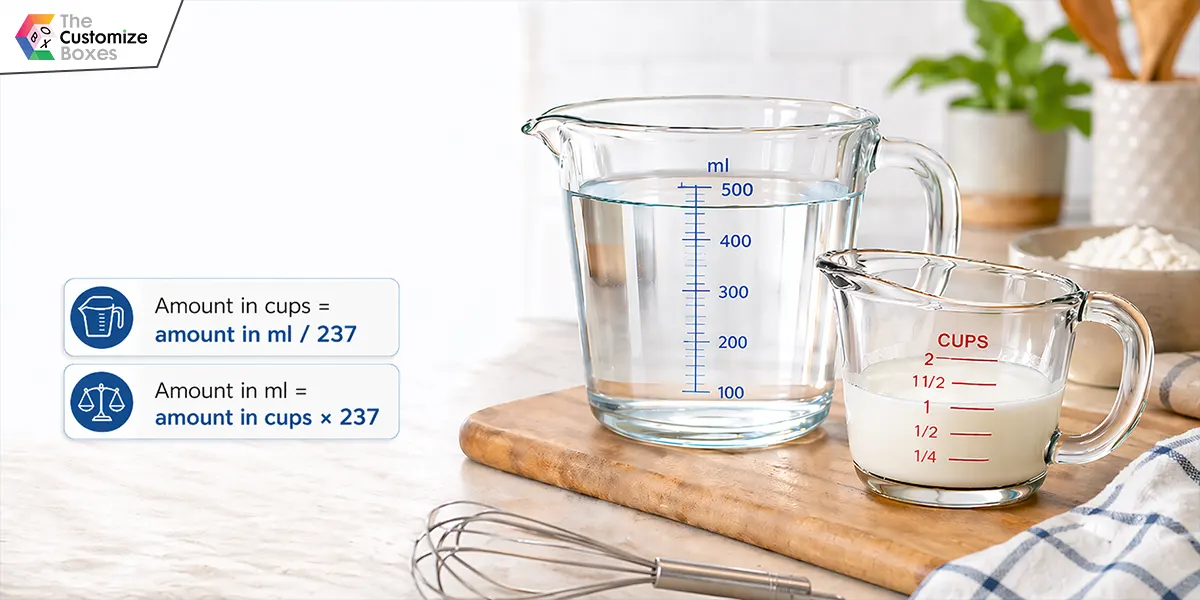
You don’t have to remember the chart to convert the ml into cups, while that may not be feasible at all. Well, the fastest way to do this task is just by remembering a simple formula and using it whenever you want. To convert ml to cups, simply divide the quantity of ml by 237.
- Amount in cups = amount in ml / 237
If the liquid volume is 500 ml, in terms of cups, it is approximately 500/237 = 2.109 cups.
Let’s take the previous data to convert the cups back to milliliters. The formula that will be followed is:
- Amount in ml = amount in cups × 237
When we calculate, this means 2.11 x 237 = 500 ml. So, it’s clear that 2.1 cups contain around 500 ml of liquid.
Popular Global Cup Capacity Standards Followed Around the Regions
As mentioned earlier, the quantity of liquid measured in one country may differ from that in another. Some follow their traditional measuring units while others follow the International System of Units. Below are some of them, briefly explaining their specific regions:
- Metric Cup (250 ml): A standard measurement scale used internationally to represent the amount of liquid content.
- US Legal Cup (240 ml): These standards are officially followed by the US government for food labeling purposes to mention the facts of nutrition.
- US Customary Cup (~236.59 ml): Another scale used to measure the liquid content locally by American kitchens or cookbooks. Also referred to as ounces, which is exactly 8 per cup.
- Imperial (UK) Cup (~284.13 ml): The Britishers follow the scale unit of liquid content as 10 Imperial fluid ounces, which is a bit more than the standard measurement unit.
- Japanese Cup (200 ml): Lastly, Japan follows the liquid measurements as 1/5 of a liter for a cup. So, where 4 cups equal 1 liter, in Japan, it’s an addition of one more cup.
Tips for Measuring Liquids Accurately
For better cooking and baking results, keep these best practices in mind:
- Use a transparent liquid measuring cup.
- Place the measuring cup on a flat surface.
- Read measurements at eye level.
- Avoid estimating ingredient quantities.
- Use measuring spoons for small liquid amounts.
- Double-check recipe measurement standards (US vs. metric).
Common Measurement Mistakes to Avoid
Many kitchen errors happen because people:
- Confuse milliliters with grams.
- Mix metric and US measuring cups.
- Estimate instead of measuring.
- Read the measuring cup from above instead of eye level.
- Forget that dry and liquid measuring cups are designed differently.
Avoiding these mistakes improves consistency in cooking and baking.
The Bottom Line
All in all, we hope you understand the conversions of millilitres to cups and how they matter in your daily life. It’s only a one-time understanding, and once you develop its concept, you can easily turn any quantity of liquid into cups. If you’re still confused, it’s highly recommended to use online conversion calculators rather than juggling with the numbers game.
Frequently asked questions
How many ml equals 1.5 cups?
Around 354.882 ml is equal to one and a half cups of liquid content. So, if someone refers to 1.5 cups, it means they say 355 ml or vice versa. Yet, this should be considered as what country’s measuring scale they’re referring to.
Does a cup equal 240 ml or 250 ml?
Both figures are correct to reflect the exact cup’s volume. The actual aspect that matters the most is what unit of measurement is being followed as per the dedicated region.
Which material cups are used to measure their volume?
The volume of the cup can be measured in any material, whether it’s paper or PET-based material. Whenever a cup is referred to, there’s no confusion in its manufacturing ingredients at all, because they all have the same dimensions.
Do cup volumes change?
Usually, the volume of the cups remains standardized, or they’re followed by the country’s local regulations. Or most of the time, the International System of Units is taken as the primary scale for measuring the cup’s volume.