
In this guide
Child-resistant mylar bags help cannabis businesses package products while reducing the risk of accidental access by children. However, using a resealable mylar bag or a durable material does not automatically make a bag child-resistant. Packaging must meet applicable safety standards, testing requirements, labeling rules, and state-specific cannabis regulations.
Businesses selling cannabis flower, edibles, concentrates, and other regulated products must understand how federal packaging standards interact with state laws. The guide explains ASTM D3475, 16 CFR 1700, and the key compliance considerations for child-resistant Mylar bags in the United States.
What are Child-Resistant Mylar Bags?
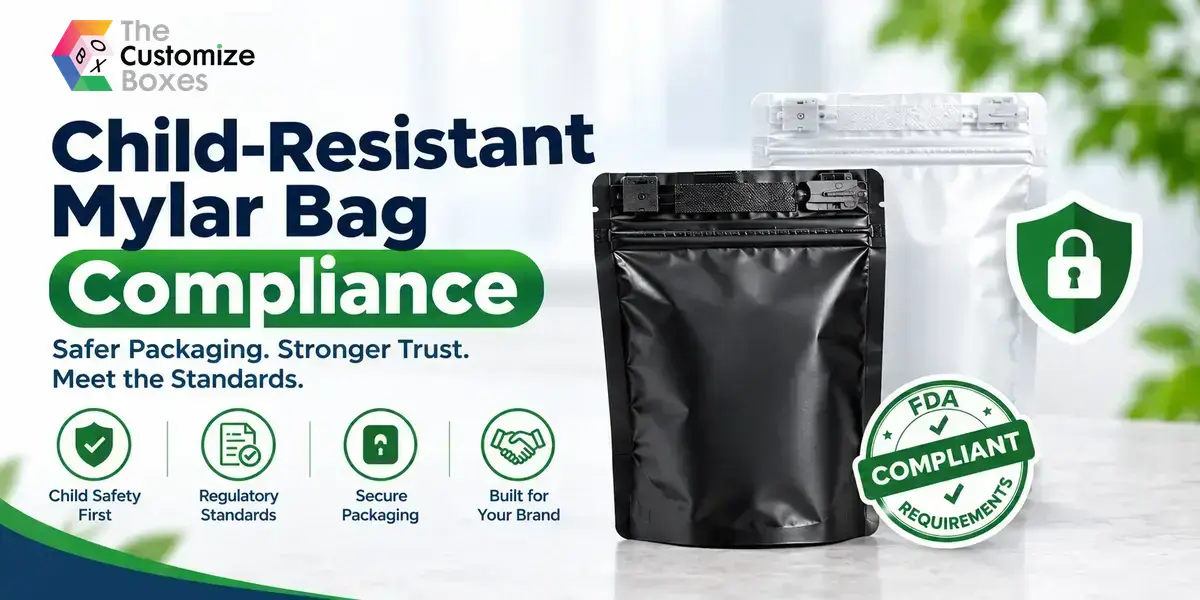
Child-resistant Mylar bags are flexible packaging pouches designed to make opening difficult for young children while remaining usable for adults. They commonly use multilayer barrier films, specialized closures, press-to-open mechanisms, or other tested designs.
These bags can help protect cannabis products from moisture, oxygen, light, and odors, depending on their construction. They are available in custom sizes, printed designs and opaque finishes. Many brands choose resealable mylar bags so customers can close the pack tightly after each use.
However, child-resistant performance depends on the complete packaging system, not simply the Mylar material. A standard zipper pouch should not be marketed as certified child-resistant unless its specific design has passed the applicable testing requirements.
Understanding ASTM D3475 and Child-Resistant Packaging
ASTM D3475 is a classification system for child-resistant packaging. This standard identifies packaging types and designs, allowing manufacturers and buyers to describe child-resistant packaging in a consistent manner.
For cannabis businesses, ASTM D3475 can be useful when evaluating packaging structures, closures, and opening mechanisms. ASTM D3475 also helps communication between packaging suppliers, product manufacturers, and compliance teams.
Nevertheless, ASTM D3475 classification alone does not prove that every package meets state requirements. Businesses must verify which performance standard applies to their product and packaging configuration.
Before ordering custom child resistant Mylar bags, confirm the following:
- The exact pouch and closure combination has been evaluated.
- The packaging design is appropriate for the intended cannabis product.
- Required child-resistance testing has been completed by a testing provider.
- Any applicable senior-adult usability requirements have been addressed.
- Changes to dimensions, materials, closures, or manufacturing processes will not invalidate the supporting test evidence.
A supplier's general claim that its packaging is child-resistant is not a substitute for test documentation.
What Does 16 CFR 1700 Require?
Title 16 of the Code of Federal Regulations, PART 1700, contains federal poison prevention packaging requirements under the Poison Prevention Packaging Act framework. Applicable rules establish performance requirements and testing procedures for special packaging.
Cannabis businesses must determine whether their specific products and packaging fall under relevant federal requirements. State cannabis laws impose additional obligations.
Important considerations include
Child-resistance testing: Applicable packaging must demonstrate the required resistance to opening by young children.
Adult accessibility
Packaging must remain accessible to adults, including older adults who may experience difficulty opening certain closures.
Package Integrity
The complete packaging system must perform as intended. A compliant closure can not compensate for a pouch design that compromises performance.
Requirements depend on the product and applicable regulations. Businesses should seek professional guidance when determining their obligations.
Child-Resistant vs Tamper-Evident Packaging
Child-resistant and tamper-evident packaging serve different purposes. Cannabis regulations may require both features.
|
Feature |
Purpose |
|
Child-resistant |
Makes opening difficult for young children |
|
Tamper-evident |
Indicates possible unauthorized opening |
|
Resealable |
Allows repeated closing |
|
Barrier protection |
Helps preserve product quality |
A tamper-evident seal does not automatically make a package child-resistant. Similarly, a child-resistant closure does not necessarily provide tamper evidence. Verify each feature against applicable requirements.
How to Verify State Compliance
- Identify the product category, such as flower, concentrates, or edibles.
- Review current rules published by the state's cannabis regulator.
- Determine whether primary packaging must be child-resistant.
- Check requirements for opacity, tamper evidence, resealability, and labeling.
- Obtain documentation supporting the exact packaging configuration.
Never assume packaging accepted in one state will automatically satisfy another state's rules.
Essential Design Features of Compliant Mylar Bags
Selecting suitable mylar bags requires evaluating materials, closures, and manufacturing consistency.
Specialized closures
Choose a closure supported by relevant child-resistant test documentation. A standard press-to-close zipper alone does not establish compliance.
Barrier materials
Multilayer films help control moisture, oxygen, light, and odor transfer. Select materials according to product protection and shelf-life needs.
Tamper evidence
Add an appropriate seal when required, ensuring it does not interfere with the child-resistant mechanism.
Custom printing
Include branding, product information, and required warnings while avoiding designs that appeal to children.
Resealability
For multi-use products, verify whether child resistance must continue after reopening.
Quality control
Ensure production bags match the tested design. Changes to dimensions, materials, closures, or sealing methods may require additional evaluation.
Testing and Documentation Checklist
Before approving production, request:
- Applicable child-resistant testing reports.
- Adult accessibility results, where required.
- Specifications that identify materials, closures, and dimensions.
- Confirmation that testing covers the packaging configuration.
- Applicable state labeling requirements.
- Quality-control procedures for production consistency.
- Testing should reflect the package being supplied, not a similar product.
Common Compliance Mistakes
Assuming every Mylar bag is child-resistant: Barrier protection does not prove child resistance.
Relying on ASTM D3475
Classification does not replace applicable performance testing.
Ignoring state differences
Requirements for labeling, opacity, and exit packaging may be different.
Changing tested designs
Modifying closures or dimensions can affect existing test evidence.
Overlooking labels
Missing warnings or required product information can create compliance problems.
Frequently asked questions
Are all Mylar bags child-resistant?
No, standard Mylar bags provide barrier protection but are not automatically child-resistant. Applicable testing and regulatory requirements must be satisfied.
What is the difference between ASTM D3475 and 16 CFR 1700?
ASTM D3475 classifies child-resistant packaging types. 16 CFR Part 1700 establishes applicable federal poison-prevention packaging requirements and testing procedures.
Do cannabis edibles require child-resistant packaging?
Requirements depend on the state, product, and packaging format. Verify applicable rules and permitted alternatives before choosing a package.
Can an exit bag replace child-resistant primary packaging?
Some jurisdictions permit alternatives in specific circumstances. This is not universal, so confirm current state requirements.
